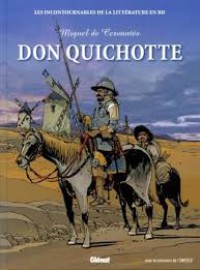
كتاب
don quichotte partie 2
Don Quixote
El ingenioso hidalgo don Quijote de la Mancha.jpg
Title page of first edition (1605)
Author Miguel de Cervantes
Original title El Ingenioso Hidalgo Don Quijote de la Mancha
Country Spain
Language Early Modern Spanish
Genre Novel
Publisher Francisco de Robles
Publication date
1605 (Part One)
1615 (Part Two)
Published in English
1612 (Part One)
1620 (Part Two)
Media type Print
Dewey Decimal
863
LC Class PQ6323
The Ingenious Nobleman Sir Quixote of La Mancha (Modern Spanish: El Ingenioso Hidalgo Don Quijote de la Mancha, pronounced [el iŋxeˈnjoso iˈðalɣo ðoŋ kiˈxote ðe la ˈmantʃa]), or just Don Quixote (/ˌdɒŋ kiːˈhoʊti/, US: /-teɪ/,[1] Spanish: [doŋ kiˈxote] (About this soundlisten); original pronunciation: [doŋ kiˈʃote]), is a Spanish novel by Miguel de Cervantes. Published in two parts, in 1605 and 1615, Don Quixote is the most influential work of literature from the Spanish Golden Age and the entire Spanish literary canon. As a founding work of modern Western literature, it regularly appears high on lists of the greatest works of fiction ever published, such as the Bokklubben World Library collection that cites Don Quixote as the authors' choice for the "best literary work ever written".[2]
The story follows the adventures of a noble (hidalgo) named Alonso Quixano who reads so many chivalric romances that he loses his sanity and decides to become a knight-errant (caballero andante), reviving chivalry and serving his country, under the name Don Quixote de la Mancha. He recruits a simple farmer, Sancho Panza, as his squire, who often employs a unique, earthy wit in dealing with Don Quixote's rhetorical orations on antiquated knighthood. Don Quixote, in the first part of the book, does not see the world for what it is and prefers to imagine that he is living out a knightly story.
Throughout the novel, Cervantes uses such literary techniques as realism, metatheatre, and intertextuality. The book had a major influence on the literary community, as evidenced by direct references in Alexandre Dumas' The Three Musketeers (1844), Mark Twain's Adventures of Huckleberry Finn (1884), and Edmond Rostand's Cyrano de Bergerac (1897), as well as the word "quixotic" and the epithet "Lothario"; the latter refers to a character in "El curioso impertinente" ("The Impertinently Curious Man"), an intercalated story that appears in Part One, chapters 33–35. The 19th century German philosopher Arthur Schopenhauer cited Don Quixote as one of the four greatest novels ever written, along with Tristram Shandy, La Nouvelle Héloïse, and Wilhelm Meisters Lehrjahre.[3]
When first published, Don Quixote was usually interpreted as a comic novel. After the French Revolution, it was popular for its central ethic that individuals can be right while society is quite wrong and seen as disenchanting. In the 19th century, it was seen as a social commentary, but no one could easily tell "whose side Cervantes was on". Many critics came to view the work as a tragedy in which Don Quixote's idealism and nobility are viewed by the post-chivalric world as insane, and are defeated and rendered useless by common reality. By the 20th century, the novel had come to occupy a canonical space as one of the foundations of modern literature.
Availability
| 16095 | 840,03/ 1545 | المكتبة الرئيسية | Available |
| 16097 | 840,03/ 1545 | المكتبة الرئيسية | Available |
| 16096 | 840,03/ 1545 | المكتبة الرئيسية | Available |
| 16094 | 840,03/ 1545 | المكتبة الرئيسية | Available |
Detail Information
- Series Title
-
-
- Call Number
-
840,03/ 1545
- Publisher
- Beirut : symphonie classique., 2011
- Collation
-
p 855
- Language
-
العربية
- ISBN/ISSN
-
-
- Classification
-
840,03/ 1545
- Content Type
-
نص
- Media Type
-
-
- Carrier Type
-
-
- Edition
-
ط 1
- Subject(s)
- Specific Detail Info
-
-
- Statement of Responsibility
-
-
Other version/related
No other version available
File Attachment
Comments
You must be logged in to post a comment
 Computer Science, Information & General Works
  Philosophy & Psychology
  Religion
  Social Sciences
  Language
  Pure Science
  Applied Sciences
  Art & Recreation
  Literature
  History & Geography